






Migraine “Vaccines”: Scientific Revolution or Expensive Hope?
Prof. Dr. F. Cankat Tulunay
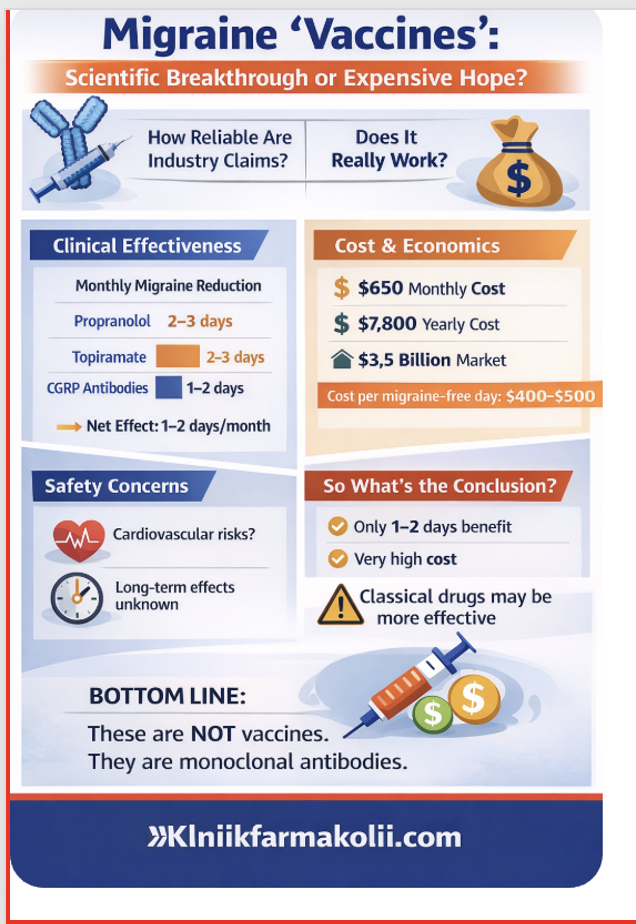
In recent years, one of the most debated developments in migraine treatment has been the drugs popularly referred to as “migraine vaccines.” However, this expression is technically incorrect. These treatments are not classical vaccines that create immunity, but monoclonal antibody drugs targeting the CGRP (calcitonin gene-related peptide) pathway. There are four main drugs in this class:
• erenumab
• fremanezumab
• galcanezumab
• eptinezumab
These drugs aim to reduce pain transmission in the trigeminovascular system by blocking the CGRP molecule or the CGRP receptor. The role of CGRP in migraine pathophysiology has long been known, and treatments targeting this molecule have created an important field of research in neurology. Nevertheless, when the scientific and commercial excitement surrounding CGRP antibodies is examined, a fundamental question emerges: Are these drugs truly a revolution in migraine treatment, or are they expensive but only limitedly effective new biological drugs?
To answer this question, the methodology of clinical trials, real-world data, cost, long-term safety data, and the economic dynamics of the migraine drug market must all be evaluated together.
The problem with clinical studies: placebo exists, active control does not
Nearly all of the studies that led to the approval of CGRP monoclonal antibodies are placebo-controlled randomized clinical trials. It is well known that the placebo effect is quite strong in migraine studies. In many studies, even in the placebo group, a reduction of 2–3 migraine days is observed. Therefore, comparing the new drug only with placebo may make its true clinical value appear greater than it actually is. An even more important methodological problem is that most of these studies do not include an active comparator arm.
In other words, in most studies CGRP antibodies were not directly compared with classical prophylactic treatments. This leaves the following question unanswered: Are these new and expensive biological drugs really more effective than the older prophylactic drugs? It is not yet possible to say a definite yes to this question.
Clinical efficacy: how much is the real benefit?
When the phase III clinical studies of CGRP antibodies are examined, a common conclusion emerges: the absolute clinical gain (the number of migraine-free days) is generally limited.
Erenumab: in the STRIVE study in episodic migraine:
• migraine days: −3.2 days
• placebo: −1.8 days
net drug effect:
≈ 1.4 days/month [1]
Fremanezumab: in the HALO study:
net effect:
≈ 1.5 days/month [2]
Galcanezumab: in the EVOLVE studies:
net effect:
≈ 1.9 days/month [3]
Eptinezumab: in the PROMISE study:
net effect:
≈ 1.1 days/month [4]
These results show that the additional benefit provided by CGRP antibodies in most patients is approximately 1–2 migraine days per month. In other words, a patient with 10 headache days per month, when using these drugs, still has 8–9 headache days.
Placebo effect: meta-analysis data
Because the placebo effect is strong in migraine studies, some researchers have tried to separate the real effect of CGRP antibodies from the placebo effect. A large systematic review and meta-analysis published in 2021 showed the following results: average total reduction: 2.8 migraine days, placebo effect: 1.8 migraine days.
Therefore, the true drug contribution is approximately 1 migraine day [17]. Likewise, network meta-analyses have shown that the efficacy of CGRP antibodies is of similar magnitude to that of existing prophylactic drugs [18].
Comparison with classical prophylactic drugs
In meta-analyses conducted with propranolol, a reduction of approximately 2–3 migraine days was reported [5]. In topiramate studies, a reduction of approximately 2–3 migraine days was also reported [6].
Therefore, the current data suggest the following: the absolute clinical efficacy of CGRP antibodies is not dramatically superior to that of classical prophylactic drugs.
Among the rare head-to-head controlled studies performed on this subject, the HER-MES study comes first. When we examine this study, which claims that these drugs are superior to classical drugs, more commercial games than science unfortunately emerge.
HER-MES: a comparative study or a deliberately designed deception scenario?
One of the most important studies attempting to determine the place of CGRP monoclonal antibodies in migraine prophylaxis is the HER-MES (Head-to-Head Study of Erenumab Against Topiramate in Patients With Episodic and Chronic Migraine) study. This study is generally presented as the strongest evidence showing the superiority of CGRP antibodies over classical prophylactic treatments. However, when the methodology, sponsorship, and researcher-industry relationships are closely examined, interpretation of the results becomes much more complex.
Full citation of the HER-MES study: Reuter U, Goadsby PJ, Lanteri-Minet M, Wen S, Hours-Zesiger P, Ferrari MD, Klatt J et al. Erenumab versus Topiramate for the Prevention of Migraine — A Randomized, Double-Blind, Active-Controlled Phase 4 Trial. Cephalalgia. 2022;42(2):108-118.
The study was designed as a phase 4, randomized, double-blind, and active-controlled trial and included a total of 777 migraine patients. Patients were divided into two arms: erenumab (Aimovig) and topiramate.
The primary endpoint of the study was not efficacy, but the rate of treatment discontinuation due to adverse events. This point is extremely important for the interpretation of the study.
Researchers and drug company relationships
The main sponsor of the HER-MES study is Novartis Pharma AG. Erenumab (Aimovig) was developed and marketed by Amgen and Novartis. In the conflict-of-interest section of the article, it is clearly stated that a significant proportion of the researchers had intense financial relationships with companies developing CGRP drugs. The principal investigator, Prof. Dr. Uwe Reuter (Charité University, Berlin), declared that he had received various payments from Amgen, AbbVie, Allergan, Eli Lilly, Novartis, and Teva. These payments included consultancy fees, speaker honoraria, and research funding.
Similarly, among the other authors of the study there are many individuals who reported financial relationships with companies developing CGRP drugs. Moreover, direct Novartis employees appear on the author list, and it is stated that some authors hold Novartis stock. In the methods section of the paper, the following information is also stated explicitly: the study design, data analysis, and preparation of the manuscript were funded by Novartis, and company-supported medical writing assistance was used in preparation of the manuscript.
In modern drug research, sponsor-supported studies are common. However, what is striking here is that many stages of the research process are intertwined with the sponsor company:
• study design
• data analysis
• manuscript writing
• some of the authors being company employees
This type of structure is often described in the scientific literature as a “high density of conflict of interest.”
The comparison drug: Topiramate
In the HER-MES study, the drug placed against erenumab was topiramate. Topiramate is a drug with proven efficacy in migraine prophylaxis. However, in clinical practice it is also one of the prophylactic treatments most frequently discontinued because of side effects. The main reasons are particularly the following side effects: cognitive slowing, word-finding difficulty, paresthesia (tingling in the hands and feet), and appetite and weight changes. These side effects of topiramate appear especially during the dose-escalation (titration) period. The primary endpoint of the HER-MES study focuses exactly on this point: the rate of discontinuation due to side effects!
The results of the study are dramatic in this respect: discontinuation rate with erenumab: 10.6%, while the discontinuation rate with topiramate was found to be 38.9%, and this previously known result was presented in many interpretations as the superiority of erenumab. However, a methodologically critical question arises here: if the comparator drug had been a better-tolerated prophylactic, would the result have been the same? For example, many clinicians ask the following question: why was propranolol or another beta blocker not chosen, but specifically topiramate? The answer is very clear: for the comparison, the drug with the highest rate of side effects was deliberately chosen.
The HER-MES study was technically designed as double-blind, double-dummy. However, in clinical practice the side effects of topiramate are so characteristic that many patients and investigators can quickly guess which drug is being used. In particular, side effects such as paresthesia, cognitive clouding, and word-finding difficulty are quite distinctive. This situation can theoretically lead to functional breakdown of the double-blind design, and both investigators and experienced patients may be able to guess the drug they are receiving.
In topiramate treatment, the dose is increased gradually. In the HER-MES study too, the topiramate dose was increased by titration over 6 weeks. The period in which topiramate is most often discontinued is precisely this titration period. Therefore, the study’s primary endpoint of “discontinuation due to side effects” turns out against topiramate because of this design.
The HER-MES study is often interpreted by the drug company as follows: “Erenumab is more effective than classical prophylactic treatments.” However, a careful reading of the article reveals a different picture. The only statistically correct conclusion that emerges from the study results is that erenumab is better tolerated than topiramate. This is an important finding.
However, presenting this finding in such a way does not scientifically mean that CGRP antibodies are generally more effective than classical prophylactic treatments.
When the HER-MES protocol is examined, the following features stand out:
• sponsor drug company
• high conflict of interest
• company employees appearing as authors
• medical writing support
• a comparison drug with a high rate of side effects
• an endpoint centered on tolerability
The combination of these factors reveals a situation frequently seen in modern drug research. How the question is asked, how the rival is selected, and how the result is framed all matter. Therefore, when evaluating the HER-MES study, this is not a protocol error, but rather a comparative study extremely cleverly designed from a commercial point of view to satisfy what the drug company wanted. The presentation of erenumab as a “revolution in migraine treatment” is a typical example of deception in modern drug research, where scientific reality is intertwined with marketing narrative.
Cost per migraine day
In the United States, the average monthly cost of CGRP antibodies is approximately 600–700 dollars. Using these figures, the approximate cost can be calculated.
Drug Net migraine days gained Monthly cost Cost per day
Erenumab ~1.6 $650 ~$406
Fremanezumab ~1.5 650 ~$433
Galcanezumab ~1.9 $650 ~$342
Eptinezumab ~1.1 $650 ~$590
This calculation shows the following: the cost of reducing a single migraine day per month can reach hundreds of dollars.
Annual patient cost
Average monthly cost: ≈ 650 dollars. Annual cost: ≈ 7,800 dollars. Ten-year treatment cost: ≈ 78,000 dollars. These figures have led to serious discussions in terms of health economics.
Real-world data
Real-world studies show that CGRP antibodies can yield better results in some patients. In some observational studies, a reduction of 3–6 migraine days or a 50% response rate of 40–60% has been reported [7–8]. However, because these studies are not randomized and do not include a control group, they do not mean very much.
Long-term safety data
CGRP is a neuropeptide that plays an important role in physiology; it has functions in vasodilation, cardiovascular regulation, and gastrointestinal function. Although side effects such as hypertension and constipation have been reported in long-term follow-up studies [10–12], long-term safety data over 10–20 years do not yet exist. In other words, we still do not know what may emerge in the future.
CGRP (Calcitonin Gene-Related Peptide) is one of the body’s most powerful vasodilators. Blocking this peptide may stop migraine attacks, but it may also temporarily disable the “vascular protection shield.”
Here are the short- and long-term possible adverse effects of CGRP antibodies and gepants on the cardiovascular system:
1. Short-term risks: hypertension and vasoconstriction
Blocking CGRP reduces its relaxing effect on vascular tone. Clinically, this is most often seen as elevated blood pressure.
• Acute hypertension: Particularly with erenumab (Aimovig), according to FDA data, severe elevations in blood pressure have been reported. In some patients this may be severe enough to require hospitalization (180/120 mmHg and above).
• Mechanism: Because erenumab blocks the CGRP receptor directly, it is thought that it may affect vascular tone more harshly than Ajovy or Emgality, which block the ligand (the peptide).
• Raynaud phenomenon: Although rare, coldness and discoloration of the fingers due to constriction in peripheral vessels (vasospastic response) have been reported.
2. Long-term and theoretical risks: the “ischemic escape” problem
The long-term effects of CGRP antibodies (5–10 years and beyond) are still being monitored with post-marketing data. The greatest concern here is the protective role of CGRP during heart attacks or strokes.
• Impairment of ischemic compensation: When a vessel is occluded (ischemia), the body naturally releases CGRP to nourish the affected area and dilate the vessels. This is a kind of “safety valve.” Because CGRP antibodies lock this valve, it is theorized that in long-term use they may increase the extent of damage during a possible heart attack or stroke.
• Cardiac remodeling: CGRP is known to have protective effects on heart muscle. The effects of years-long blockade on heart failure or left ventricular hypertrophy have not yet been fully clarified.
• Angina pectoris: In people with coronary artery disease, CGRP blockade may lower the threshold for chest pain (angina).
3. Cardiovascular risk groups: who should be cautious?
Because clinical trials generally select “healthy” migraine patients, real-world data suggest that the following groups require greater caution:
Risk Factor Point Requiring Attention
Uncontrolled hypertension Blood pressure must be regulated before the drug is started.
Coronary artery disease In patients with stents or bypass surgery, CGRP blockade may lower the “ischemic threshold.”
History of stroke Restriction of vasodilation may be risky in patients with low cerebrovascular reserve.
Diabetic vasculopathy Tissue perfusion may be impaired in those with microvascular damage.
“Invisible risk”
The half-lives of CGRP antibodies are very long (approximately 28 days). This means the following: if a patient has taken the drug dose and then suffers a heart attack one week later, it is not possible to remove the drug from the body immediately. The blocking effect continues for weeks. This situation may lead to the patient’s death during an acute vascular event.
Limits of CGRP theory
Migraine pathophysiology is a complex neurovascular disorder. CGRP is not the only responsible system. The serotonergic system, dopaminergic system, ion channels, cortical spreading depression, and central nervous system sensitization also play very important roles in migraine. For this reason, treatments that target a single molecule may not be effective in all patients [9].
The political economy of the biological migraine drug market
Migraine affects approximately 1 billion people worldwide [14]. The migraine drug market is estimated at approximately 5–6 billion dollars [15]. Sales of CGRP drugs are projected to reach approximately 15 billion dollars by 2030 [16].
Main CGRP drugs: DrugCompany 2023 sales
Aimovig Amgen / Novartis ≈ $1.4 billion
Emgality Eli Lilly ≈ $1.3 billion
Ajovy Teva ≈ $0.8 billion
Total market size: ≈ $3–4 billion [19]. For this reason, CGRP antibodies are an important source of revenue for the pharmaceutical industry.
Industry influence in migraine research
A significant portion of clinical studies in the migraine field has been financed by pharmaceutical companies. Many researchers report financial relationships such as consultancy, speaker fees, and research grants. This raises discussions in the literature about conflict of interest.
The situation in Turkey
The use of CGRP antibodies in Turkey is limited. The main reasons are high cost and SGK reimbursement restrictions. For this reason, they are generally used in refractory migraine patients, although misuse is also possible.
Conclusion
CGRP monoclonal antibodies represent an important scientific advance in migraine treatment. However, current data reveal several important points: the absolute clinical benefit is usually only 1–2 days/month and there is no superiority over classical prophylactic drugs. Many patients are spending thousands of lira because of misinformation. In addition, the long-term effects and side effects of none of these drugs are known. CGRP monoclonal antibodies may be useful in migraine prophylaxis, but they are ultimately limited-effect, expensive biological therapies.
References
-
Goadsby PJ, Reuter U, Hallström Y et al. A Controlled Trial of Erenumab for Episodic Migraine. New England Journal of Medicine. 2017; 377: 2123–2132.
-
Dodick DW, Silberstein SD, Bigal ME et al. Effect of Fremanezumab Compared With Placebo for Prevention of Episodic Migraine: A Randomized Clinical Trial. JAMA. 2018; 319: 1999–2008.
-
Stauffer VL, Dodick DW, Zhang Q, Carter JN, Ailani J, Conley RR. Evaluation of Galcanezumab for the Prevention of Episodic Migraine: The EVOLVE-1 Randomized Clinical Trial. JAMA Neurology. 2018; 75: 1080–1088.
-
Lipton RB, Goadsby PJ, Smith J et al. Efficacy and Safety of Eptinezumab in Patients With Episodic Migraine: PROMISE-1 Trial. Lancet Neurology. 2020; 19: 814–825.
-
Linde K, Rossnagel K. Propranolol for migraine prophylaxis. Cochrane Database of Systematic Reviews. 2013.
-
Brandes JL, Saper JR, Diamond M et al. Topiramate for Migraine Prevention: A Randomized Controlled Trial. JAMA. 2004; 291: 965–973.
-
Ornello R, Casalena A, Frattale I et al. Real-world effectiveness of anti-CGRP monoclonal antibodies in migraine prevention. Neurology. 2020.
-
Barbanti P, Aurilia C, Egeo G, Fofi L. Erenumab in high-frequency episodic and chronic migraine: Real-world experience. Journal of Headache and Pain. 2021.
-
Ashina M, Terwindt GM, Al-Karagholi MA et al. Migraine: disease characterisation, biomarkers and precision medicine. Nature Reviews Disease Primers. 2021.
-
Tepper S, Ashina M, Reuter U et al. Long-term safety and efficacy of erenumab in patients with episodic migraine. Neurology. 2020.
-
Ashina M, Saper J, Cady R et al. Long-term safety of CGRP monoclonal antibodies in migraine prevention. Lancet Neurology. 2022.
-
Edvinsson L. The CGRP pathway in migraine as a target for therapy. Physiological Reviews. 2019; 99: 1207–1248.
-
Institute for Clinical and Economic Review. Calcitonin Gene-Related Peptide (CGRP) Inhibitors as Preventive Treatments for Migraine: Effectiveness and Value. Boston: ICER Report; 2020.
-
GBD Headache Collaborators. Global, regional and national burden of migraine and tension-type headache, 1990–2016. Lancet Neurology. 2018; 17: 954–976.
-
Grand View Research. Migraine Drugs Market Size, Share and Trends Analysis Report. San Francisco: Grand View Research; 2023.
-
Evaluate Pharma. World Preview: Outlook to 2030 – Pharmaceutical Market Forecast. Evaluate Ltd; 2022.
-
Deng H, Li GG, Nie H et al. Calcitonin gene-related peptide monoclonal antibodies for migraine prevention: systematic review and meta-analysis. Cephalalgia. 2021.
-
Yuan H, Lauritsen CG, Kaiser EA, Silberstein SD. Network meta-analysis of migraine preventive treatments. Journal of Headache and Pain. 2021.
-
Evaluate Pharma. Global Sales of Anti-CGRP Migraine Drugs Industry Report. Evaluate Pharma; 2023.
Note: AI assistance was used in the preparation of this article.